 Listen on
  Listen on
Episode Summary
In this episode of The Marketing Rapport, host Tim Finnigan sits down with Lucas Thelosen, Founder & CEO of Orion by Gravity, and former Head of Product for Data & AI at Google Cloud to unpack what actually separates data-driven companies from the ones that only claim to be. Drawing on his experience working alongside Uber, Walmart, Amazon, Warby Parker, and On Running, Lucas explains why the most competitive markets consistently produce the most sophisticated data practices, and how a compounding 2% edge translates into billion-dollar valuation gaps over time.
The conversation moves from diagnosis to prescription: why messy data is no longer a valid excuse in the age of AI, how “context engineering” is emerging as the most valuable new skill in the enterprise, and why the future of every job — from analyst to CMO — is orchestration and management of AI agents. Lucas also shares practical advice for building a data culture from both the top down and the bottom up, including the underrated importance of turning spreadsheets into polished narratives that leadership actually acts on.
The episode closes with a forward-looking discussion on synthetic user cohorts, the death of the data scientist as data janitor, and why young professionals who learn to architect context now will define the next decade of marketing and analytics.
Guest-at-a-Glance
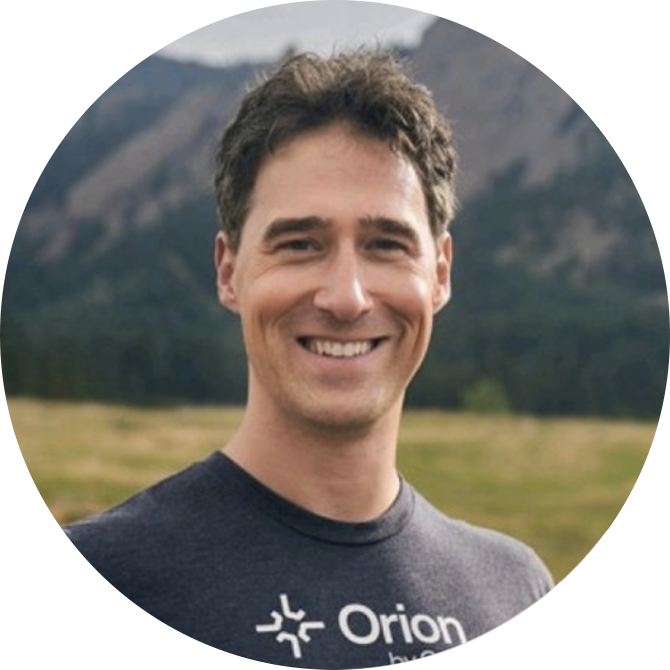
- Name: Lucas Thelosen
- What they do: Founder & CEO
- Company: Gravity (makers of Orion, an AI data analyst platform)
- Background: Former Head of Product, Data & AI at Google Cloud; early executive at Looker (through Google acquisition); founded a global Looker consulting firm that grew to 120+ consultants working with Uber, Lyft, Amazon, Walmart, Shopify, Warby Parker, and On Running.
- Guest Company Website: bygravity.com
- LinkedIn: linkedin.com/in/thelosen
Key Insights
- The Most Competitive Markets Always Produce the Most Sophisticated Data Practices.
Lucas observed a striking pattern across his career: cutting-edge data products consistently cluster in whichever industry is currently most competitive. In 2015 it was ride-sharing (Uber vs. Lyft). In 2017 it was food delivery. Today it’s retail and financial services. The lesson for marketers isn’t just that data matters — it’s that when margins compress and competitors converge, marginal analytical gains become existential. A 2% annual edge compounds into a valuation chasm within a few years, which is why the companies willing to “turn over stones” and challenge their own theses tend to become category leaders, while those seeking data only to confirm existing decisions plateau or decline.
- Messy Data Is No Longer a Valid Excuse — Context Is the New Bottleneck.
For decades, the standard rationale for delayed analytics was “our data isn’t ready yet.” Lucas argues this excuse has expired. Modern AI systems can now ingest imperfect data, derive relationships from query history and metadata, and produce meaningful analysis without the traditional 80–90% data cleanup burden that used to define a data scientist’s job. The real bottleneck has shifted to context engineering — the practice of documenting how a business actually thinks, defines metrics, and makes decisions. Companies that invest in maintaining living context (documentation, ambient learning from chat platforms, definitions of who does what) will outperform those still trying to perfect their data warehouse.
- Every Future Job Is an Orchestration Job.
Lucas’s forecast for the next five years is direct: nearly every knowledge worker will become a manager, orchestrator, or architect of AI agents. This isn’t a philosophical claim — it’s a product roadmap. Organizations will need Chief Operating Officers for AI, performance reviews for agents, and context engineers who maintain the institutional knowledge that AI systems depend on. For young professionals, this represents the same kind of career opening social media created in the early 2000s: none of the incumbents have expertise, so 20 minutes of serious thinking already positions you ahead of most of the market.
- Data Culture Is Built Through Repetition and Curated Storytelling, Not Mandates.
Lucas is skeptical of board mandates to “become data-driven.” The companies that actually get there share two behaviors: leaders who constantly reference numbers in meetings (modeling the behavior), and analysts who invest in making their findings presentable — polished slide decks, clear narratives, and one insight per slide. He notes that most people are relationship-driven, not spreadsheet-driven, so making data approachable and career-relevant is what turns a curious individual contributor into a company-wide movement. The McKinsey stereotype of endless decks exists for a reason: storytelling is what makes data actionable.
Episode Highlights
Why the Most Data-Driven Companies Cluster in the Most Competitive Industries
~00:04:37
Lucas describes a career-long pattern of working with whichever industry happened to be the most competitive at that moment — ride-sharing, food delivery, retail. The insight is that data sophistication follows margin pressure. When any small edge matters, companies invest in the tooling and talent to find those edges, which is why marketing has been at the forefront of data analysis for over a decade.
“There is this interesting theme with data where you tend to work as a cutting-edge product, you tend to be within the most competitive markets… any tiny marginal gain you can have over your competition becomes so important.” — Lucas Thelosen
The Empowered-Curiosity Test That Separates Data Leaders from Laggards
~00:08:06
Lucas contrasts two approaches he’s seen firsthand: utility and cable companies that explicitly did not want anyone finding surprises in the data, versus Walmart openly inviting consultants to hunt for supply chain inefficiencies. The willingness to be contradicted by your own data, he argues, is the single most predictive cultural marker of whether a company will compound its analytical advantages over time.
“We all want to have data that supports the decision we already made. Like if you think about it, I don’t really want a report that contradicts me.” — Lucas Thelosen
Messy Data Is No Longer the Blocker It Used to Be
~00:13:33
Lucas directly challenges the most common excuse for delayed analytics initiatives. He explains how modern AI systems, including Orion, can derive schema understanding, table relationships, and business meaning from metadata and query history — eliminating the traditional data-scientist tax of spending 80–90% of time on cleanup.
“In the past, a data scientist’s job was 80% getting the data, or maybe 90% getting the data into a good spot. That is no longer the case.” — Lucas Thelosen
Synthetic User Cohorts and the Case Against Individual-Level Targeting
~00:18:22
Lucas explains why he cares about groups of 1,000 or 10,000 lookalike consumers rather than individuals — both for privacy reasons and because pattern reliability improves at cohort scale. Tim chimes in with the classic Amazon example: getting retargeted for D-batteries the day after buying D-batteries, illustrating how even the world’s most sophisticated retailers still fail at basic cohort-informed decisioning.
“I don’t care about the individual… I care about 10,000 people that look alike or 1,000 people that look alike, and put them into a cohort because they behave similarly if you look at the patterns.” — Lucas Thelosen
The Coming Rise of the Context Engineer
~00:31:24
Lucas makes his boldest career prediction of the episode: context engineering will be to the 2020s what social media was to the early 2000s — a field where no incumbents have expertise, meaning any professional who takes it seriously can become a recognized authority quickly. He argues that every organization has done a poor job documenting how it operates, and AI systems now make that documentation directly monetizable.
“None of the old people, us included, know anything about context engineering. And you can say you have expertise in context engineering because you thought about it for 20 minutes, and that already is way more than most people.” — Lucas Thelosen
Top Quotes
Lucas Thelosen [~00:00:00]
“We build a product for that future. And the future is gonna be people that can orchestrate, people that can manage. In the future, everybody is a manager of some sort, an orchestrator of some sort, an architect.”
Lucas Thelosen [~00:07:21]
“If you’re just like 2% better than your competition every year, a couple years later you’re significantly ahead.”
Lucas Thelosen [~00:08:31]
“With companies that are not really that data-driven, you see this over and over where people actually just want results that support their thesis.”
Lucas Thelosen [~00:12:01]
“Every company thinks they’re so unique… they made the data very unique and different from other companies. But the underlying things are the same. You acquire customers, you sell products, you manage inventory, you ship goods.”
Lucas Thelosen [~00:15:22]
“Context is important. You have to have your context in order. The way I think of context is: what is your documentation for the new employee joining the company?”
Lucas Thelosen [~00:18:48]
“There’s no point advertising to me two weeks after I just bought a pair, because I’m not gonna buy another pair. So save your advertising.”
Lucas Thelosen [~00:19:16]
“I bought D-batteries, and the next day I get ads for D-batteries from Amazon. Someone who just bought 10 D-batteries does not need more D-batteries.”
Lucas Thelosen [~00:25:25]
“The vast majority of people would like to have a coffee chat, talk to their good friend, and do what their friends think they should do. We’re relationship people. We’re not behind a screen looking at spreadsheets making ice cold decisions on numbers.”
Lucas Thelosen [~00:28:19]
“If you present it to me, you now put your signature under it. You gotta take full ownership, not just for the great parts, also for the mistakes made.”
Tim Finnigan [~00:29:23]
“Storytelling is by far one of my most favorite things to do when you’re presenting… If the data point is 14%, that’s one of the only things that you should have on the slide. Tell the story, don’t read from your slides.”
Lucas Thelosen [~00:32:20]
“You’ll have performance reviews, in essence, for AI agents.”
 Your Privacy Choices